How AI Is Changing the Way We Search for Information
August 21, 2026
0
AI Powered Search The way people search for information is changing rapidly. For years, search engines have primarily helped users find webpages by matching keywords with relevant content.
AI Powered Search
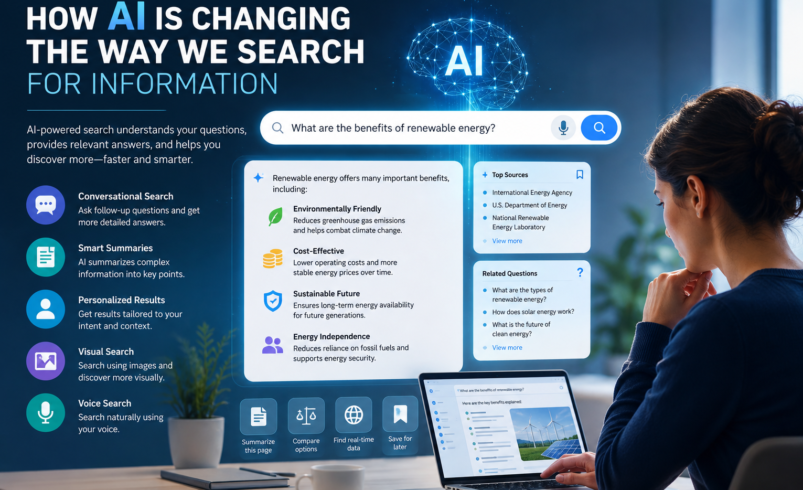
The way people search for information is changing rapidly. For years, search engines have primarily helped users find webpages by matching keywords with relevant content. Today, artificial intelligence is making search more conversational, personalized, and interactive.
Instead of simply entering a few keywords and browsing through a list of links, people can increasingly ask complete questions and receive summarized explanations, follow-up suggestions, and more direct answers.
“The future of search is not just finding information—it is understanding what people are really looking for.”
From Keywords to Natural Questions
Traditional search often required users to choose the right keywords. AI-powered search allows people to use everyday language instead.
For example, instead of searching for:
“best laptop student budget”
a user can ask:
“What is a good laptop for a college student who needs it for studying, video calls, and light photo editing?”
AI can interpret the context behind the question and provide a more focused response.
AI Makes Search More Conversational
One of the biggest changes introduced by AI is the ability to continue a search through a conversation.
Ask Follow-Up Questions
Users can ask additional questions without repeating the entire context.
For example:
Ask for travel destination suggestions.
Ask which destination is more affordable.
Ask about the best season to visit.
Ask what to pack.
Ask for a sample itinerary.
This creates a more natural information-search experience.
AI Can Summarize Complex Information
The internet contains an enormous amount of information, but finding the most useful points can take time.
AI can help summarize lengthy material into easier-to-understand explanations.
Turning Long Information Into Key Points
AI-powered tools can assist users in understanding:
Long articles
Research papers
Reports
Product information
Technical subjects
News and current events
Educational materials
However, summaries should not always be treated as a replacement for reading the original source, especially when the information is important or highly detailed.
Search Is Becoming More Personalized
AI can use context from a user’s question to provide more relevant results.
Understanding User Intent
Consider someone searching for “jaguar.”
They could be looking for:
The animal
The car brand
A sports team
Something else with the same name
AI can use the surrounding question and context to better understand what the person means.
This ability to recognize intent can make search results more useful.
AI Helps With Complex Questions
Traditional search works particularly well for straightforward queries. AI can be especially useful when a question involves multiple requirements.
For example, a person might ask:
“I have a small business, a limited marketing budget, and only a few hours each week. What digital marketing strategies should I prioritize?”
This type of question requires understanding several factors rather than matching a single keyword.
Visual Search Is Becoming More Powerful
AI is also changing how people search using images.
Instead of describing an object with words, users can upload or capture an image and ask questions about it.
Examples of Visual Search
AI-powered visual search can help users:
Identify objects
Understand images
Find similar products
Extract text from pictures
Analyze visual information
Learn about places or items
This creates another way to interact with information beyond typing.
AI-Powered Search
Voice Search and AI
Voice assistants have already made spoken search popular. Generative AI is taking this experience further by making interactions more conversational.
Users can speak naturally rather than constructing short search phrases.
Why Voice Search Matters
Voice-based AI can be useful when people are:
Driving
Cooking
Exercising
Working with their hands
Looking for quick answers
Using mobile devices
As AI becomes better at understanding natural language, voice-based information retrieval may become increasingly common.
AI Is Changing Online Research
Students, professionals, writers, and researchers often need to gather information from multiple sources. AI can help organize and summarize information during the research process.
Research Becomes More Interactive
Instead of opening many webpages and manually comparing them, users can use AI to:
Generate research questions
Explain difficult concepts
Summarize information
Compare different ideas
Create outlines
Identify areas that require further research
Reliable sources should still be checked directly when accuracy matters.
The Importance of Source Verification
AI-powered search can make finding information faster, but speed does not automatically mean accuracy.
AI systems can sometimes misunderstand information or produce incorrect answers.
Check Important Information
Users should verify important facts by consulting trustworthy sources, particularly for:
Medical information
Financial decisions
Legal questions
Academic research
Technical specifications
Current events
AI should help people find and understand information, not eliminate the need for critical thinking.
AI Is Changing How Websites Create Content
The rise of AI search is also affecting website owners and content creators.
Simply creating pages filled with keywords may no longer be enough to attract users.
Focus on Helpful Content
Websites should provide:
Clear answers
Useful explanations
Original insights
Reliable information
Strong organization
Relevant examples
Good user experiences
Content should be created primarily for people rather than only for search algorithms.
The Future of Search
Search is likely to become increasingly integrated with AI assistants, voice interfaces, visual tools, and personalized experiences.
Users may not always need to visit multiple websites to find basic information. Instead, AI could help them understand a topic first and then guide them toward useful sources, products, services, or deeper information.
Search Could Become More Predictive
Future systems may become better at understanding what users need based on context and previous interactions.
For example, instead of simply responding to a question, an AI assistant might help users compare options, organize information, and complete the next steps of a task.
Benefits of AI-Powered Search
AI-driven search offers several potential advantages:
Faster Information Discovery
Users can spend less time browsing through irrelevant results.
Better Understanding
Complex topics can be explained in simpler language.
More Natural Interaction
People can ask questions the same way they would ask another person.
Multiple Ways to Search
Text, voice, and images can all become part of the search experience.
More Personalized Results
AI can use context to make information more relevant to the user’s needs.
Challenges of AI-Powered Search
AI-powered search also presents important challenges.
Accuracy
Incorrect AI-generated information can lead users to wrong conclusions.
Source Transparency
Users need to understand where important information comes from.
Privacy
Personalized search systems may process user information, making privacy and data protection important considerations.
Information Overload
Even AI-generated answers can contain too much information. Users still need to identify what is relevant to their specific situation.
How Users Can Search More Effectively With AI
To get better results from AI-powered search, users should provide useful context.
Be Specific
Instead of asking:
“Best phone?”
try:
“What are the best smartphones under my budget for photography, battery life, and everyday use?”
Ask Follow-Up Questions
Use follow-up questions to refine the answer rather than starting over each time.
Request Comparisons
Ask AI to compare options according to specific factors such as price, features, performance, or suitability.
Verify Important Claims
Use reliable sources to confirm information before making significant decisions.
Final Thoughts
AI is transforming search from a simple process of finding webpages into a more interactive way of discovering, understanding, and using information.
People can now ask questions naturally, explore topics through conversation, analyze images, summarize complex information, and receive more context-aware answers.
However, the fundamentals of good information discovery remain important. AI can make searching faster and easier, but critical thinking, source verification, and human judgment are still essential.
As AI continues to evolve, the future of search will likely focus less on simply finding information and more on helping people understand and use it effectively.