
Top Technology Trends That Could Shape the Future
- August 21, 2026
- 0
Top Technology Trends That Could Shape the Future Technology is evolving at an incredible pace, changing the way people work, communicate, travel, shop, learn, and interact with the


Top Technology Trends That Could Shape the Future Technology is evolving at an incredible pace, changing the way people work, communicate, travel, shop, learn, and interact with the
Technology is evolving at an incredible pace, changing the way people work, communicate, travel, shop, learn, and interact with the world. Innovations that once seemed like science fiction are increasingly becoming part of everyday life.
From artificial intelligence and robotics to quantum computing and connected devices, emerging technologies are expected to influence businesses and society in significant ways. Understanding these trends can help individuals and organizations prepare for the opportunities and challenges ahead.
“The future belongs to those who understand technology and use it to create meaningful change.”
Artificial intelligence (AI) is one of the most influential technology trends shaping the future. AI systems are already being used for customer support, content creation, data analysis, healthcare, education, cybersecurity, and business automation.
Future AI systems are expected to become more capable of understanding complex information, assisting with decision-making, and handling increasingly sophisticated tasks.
AI may become even more deeply integrated into smartphones, vehicles, homes, workplaces, and online services. Personalized recommendations, intelligent assistants, automated workflows, and predictive tools could become standard features across many industries.
Generative AI can create text, images, audio, video, software code, and other forms of digital content based on user instructions.
Businesses are already exploring generative AI to improve productivity and accelerate creative processes.
Instead of completely replacing human creativity, AI tools may increasingly work alongside people. Writers, designers, programmers, marketers, researchers, and other professionals can use AI to generate ideas, automate repetitive tasks, and explore new possibilities.
Human judgment, creativity, and fact-checking will remain important as these tools become more advanced.
The Internet of Things (IoT) connects physical devices to networks so they can collect, exchange, and process information.
Smart watches, home appliances, security systems, industrial equipment, vehicles, and environmental sensors are examples of connected devices.
Future IoT systems could help homes automatically manage energy consumption, security, lighting, and appliances. At a larger scale, connected technologies could support smart transportation systems, public infrastructure, waste management, and energy networks.
Quantum computing represents a fundamentally different approach to processing information. Instead of relying solely on traditional computing methods, quantum computers use principles of quantum mechanics to handle certain types of complex problems.
Although practical large-scale quantum computing is still developing, it could eventually have applications in areas such as:
The technology remains challenging, but its potential makes it an important area to watch.
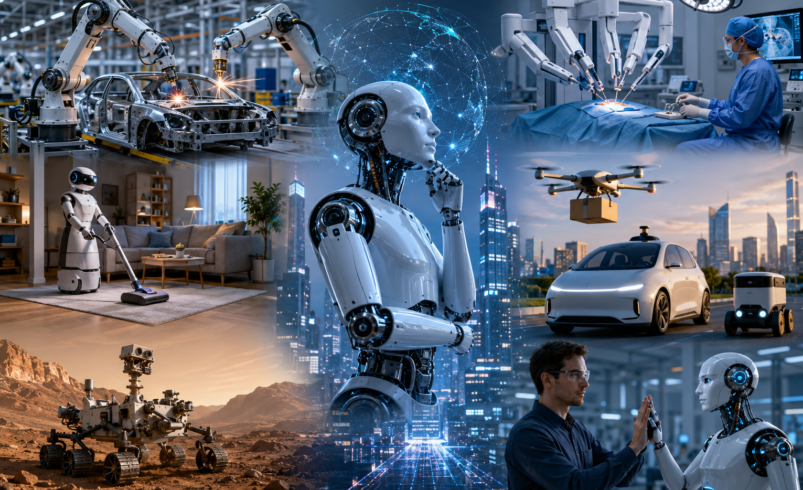
Robotics is moving beyond traditional industrial machines. Advances in AI, sensors, computer vision, and mechanical engineering are helping robots become more adaptable.
Future robots could play a larger role in warehouses, healthcare, agriculture, manufacturing, logistics, and household environments.
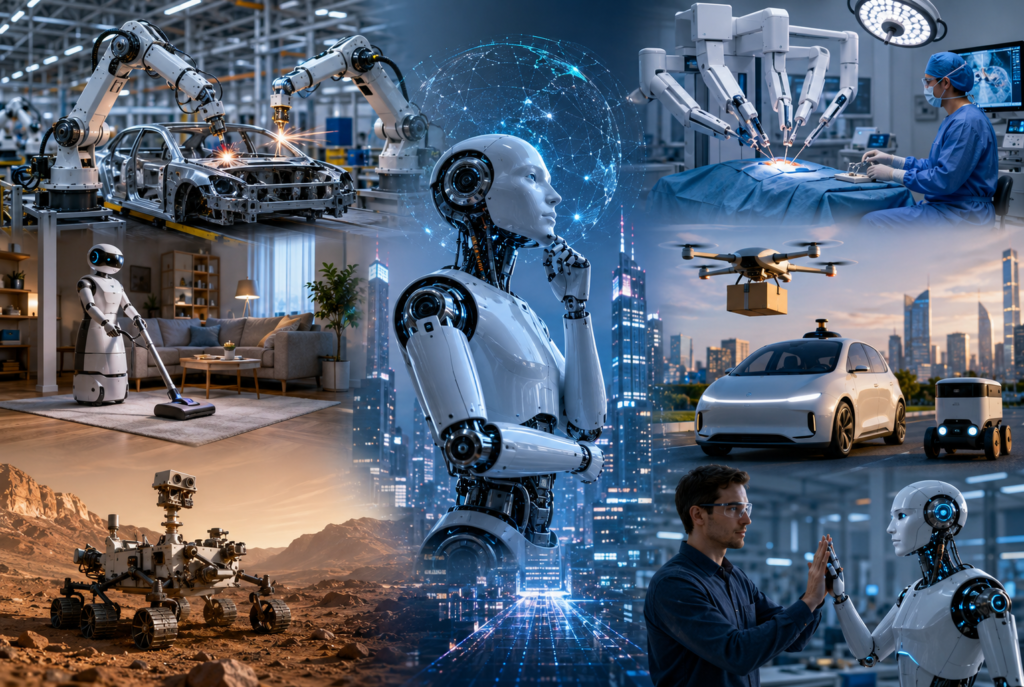
Rather than robots simply replacing people, many workplaces may increasingly use robots to perform dangerous, repetitive, or physically demanding tasks while humans focus on supervision, creativity, and decision-making.
Virtual reality (VR), augmented reality (AR), and mixed reality (MR) are collectively helping create more immersive digital experiences.
These technologies could influence entertainment, education, healthcare, tourism, engineering, retail, and professional training.
Students could explore virtual environments instead of relying exclusively on traditional classrooms. Employees could receive realistic training simulations, while businesses could use augmented information to assist workers in real-world environments.
As more devices and services become connected, cybersecurity threats are also likely to become more sophisticated.
Organizations will need stronger methods for protecting networks, applications, devices, and personal information.
Future cybersecurity strategies may increasingly use AI-powered threat detection, stronger authentication, encryption, automated monitoring, and zero-trust security models.
Individuals will also need to maintain good digital habits, including using strong passwords, enabling multi-factor authentication, and recognizing phishing attempts.
Advances in computing, AI, genetics, medical devices, and biotechnology are opening new possibilities in healthcare and life sciences.
Technology could help researchers analyze large biological datasets, discover potential treatments, improve diagnostics, and develop more personalized approaches to healthcare.
The combination of technology and biology could become one of the most important areas of innovation in the coming decades.
Climate concerns and increasing energy demands are driving innovation in sustainable technology.
Renewable energy systems, electric vehicles, energy-efficient buildings, battery technology, smart grids, and carbon-reduction solutions are examples of areas receiving increasing attention.
Technology can help organizations reduce waste, monitor energy usage, optimize transportation, and improve resource management. The future of innovation will likely focus not only on performance but also on environmental sustainability.
Faster and more reliable connectivity can support increasingly connected devices and digital services.
5G is already enabling applications involving connected vehicles, industrial automation, smart cities, remote collaboration, and IoT devices. Future generations of mobile networks could provide even greater capacity and lower latency.
Traditional cloud computing often involves sending data to centralized data centers for processing. Edge computing moves some processing closer to the devices generating the data.
This can be particularly useful for applications that require rapid responses, such as autonomous vehicles, industrial systems, smart cameras, and connected healthcare devices.
Processing data closer to its source can reduce latency and potentially improve efficiency. As the number of connected devices grows, edge computing could become increasingly important.
Autonomous systems are being developed for vehicles, drones, warehouses, agriculture, and industrial environments.
Self-driving technology remains a complex challenge, but advances in sensors, AI, mapping, and machine learning continue to push the field forward.
In the future, autonomous systems could help improve transportation efficiency, logistics, agriculture, and workplace safety.
The most important development may not be a single technology but the combination of several technologies.
For example, AI can analyze data generated by IoT devices, edge computing can process that information quickly, 5G can connect devices, and robotics can act on the results.
This convergence could create entirely new products, services, and ways of working.
Technological progress also brings important challenges. Privacy, cybersecurity, job displacement, digital inequality, misinformation, ethical AI, and responsible data usage will require careful consideration.
Governments, businesses, researchers, and communities will need to work together to ensure emerging technologies are developed and used responsibly.
Businesses can prepare by monitoring emerging technologies and identifying areas where innovation could provide real value.
Some useful strategies include:
The future of technology will likely be defined by rapid innovation and the convergence of multiple technologies. Artificial intelligence, robotics, quantum computing, IoT, extended reality, cybersecurity, biotechnology, and green technology could all play important roles in shaping the years ahead.
While nobody can predict exactly what the future will look like, one thing is clear: technology will continue to influence how we live and work. Staying informed, adaptable, and responsible will be essential as these innovations become part of everyday life.