
How Technology Is Transforming Online Shopping
- August 21, 2026
- 0
Online shopping has changed dramatically over the past few years. What started as a convenient way to purchase products from a website has evolved into a highly personalized


Online shopping has changed dramatically over the past few years. What started as a convenient way to purchase products from a website has evolved into a highly personalized
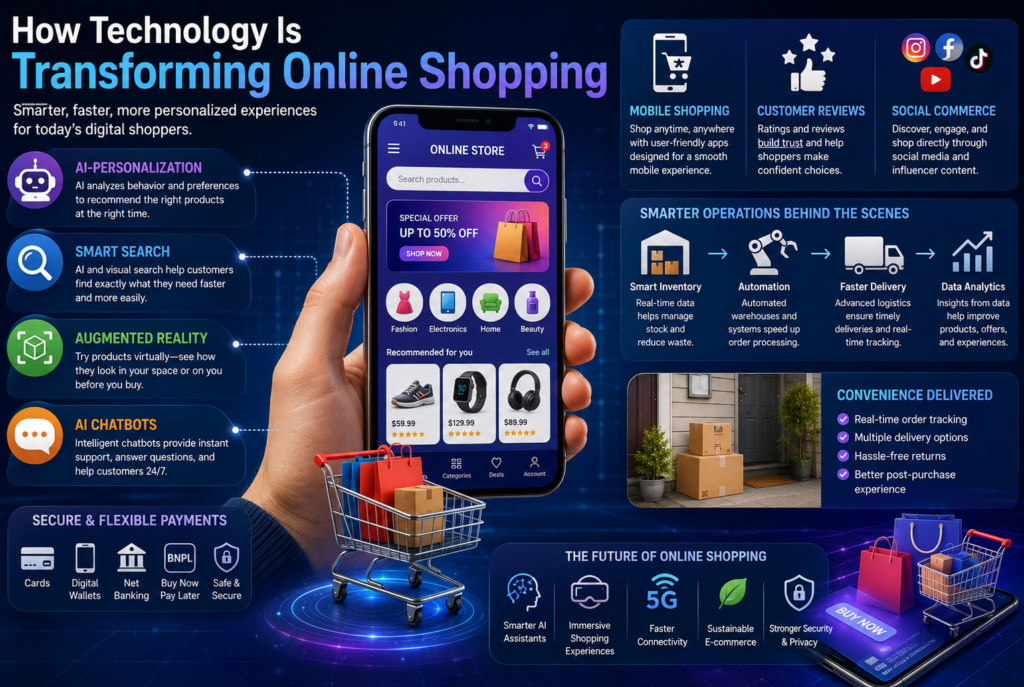
Online shopping has changed dramatically over the past few years. What started as a convenient way to purchase products from a website has evolved into a highly personalized digital experience powered by artificial intelligence, mobile technology, data analytics, automation, and advanced payment systems.
Today, customers can discover products through social media, compare prices instantly, try virtual products through augmented reality, receive personalized recommendations, and complete purchases from almost anywhere.
“Technology is turning online shopping from a simple transaction into a personalized digital experience.”
The internet has made it possible for customers to shop without visiting a physical store. Online marketplaces and brand websites allow people to browse thousands of products from the comfort of their homes.
Customers can:
This convenience has become one of the biggest reasons people continue to embrace online shopping.
Smartphones have made online shopping more accessible than ever. Customers no longer need a desktop computer to browse products or place orders.
Retail apps can provide features such as:
Mobile-friendly websites and applications have therefore become essential parts of modern e-commerce.
Artificial intelligence is one of the most important technologies transforming online retail.
AI can analyze customer interactions and product information to provide more relevant experiences.
Online stores can recommend products based on factors such as browsing activity, previous purchases, and product interests.
For example, a customer looking at running shoes may receive recommendations for sports clothing, socks, or fitness accessories.
This can make product discovery faster while helping retailers improve customer engagement.
AI assistants are becoming increasingly useful in e-commerce.
Instead of searching through multiple categories, customers can describe what they need in natural language.
For example:
“I need a lightweight laptop for office work and video meetings.”
An AI shopping assistant can help narrow down suitable options based on the customer’s requirements.
Voice technology is also changing how people search for products.
Customers can use voice assistants to search for items, check product information, and perform certain shopping tasks.
Voice-based shopping can be particularly convenient when users are:
As voice recognition improves, conversational shopping may become more common.
One of the biggest challenges of online shopping is that customers cannot physically examine a product before purchasing it.
Augmented reality is helping address this problem.
Depending on the product and retailer, AR can allow customers to:
This can give shoppers more confidence before completing a purchase.
Virtual reality could take online shopping a step further by creating more immersive digital environments.
Instead of simply viewing product pages, customers could potentially explore virtual stores and interact with products in a simulated environment.
Although adoption varies, immersive commerce could become more significant as hardware and software improve.
Technology is making product discovery easier.
Instead of typing a product description, shoppers can use an image to search for similar products.
For example, a customer could upload a picture of a particular style of furniture or clothing and use visual search to discover similar items.
AI-powered search can also understand natural-language descriptions and identify products based on multiple requirements.
This makes product discovery more intuitive.
Online stores need to provide quick answers to customer questions.
AI-powered chatbots can assist customers with common requests.
They may help customers:
This allows customer service teams to focus on more complex issues.
Payment technology has also transformed online shopping.
Customers can now choose from different payment methods depending on the retailer and region.
These may include:
Fast and secure checkout experiences can reduce friction and make purchasing more convenient.
The shopping experience does not end when an order is placed. Technology is also changing how products are stored, processed, and delivered.
Customers can often track their orders and receive updates about delivery progress.
This provides greater visibility and reduces uncertainty after purchase.
Retailers can use automation, robotics, and software systems to organize inventory and process orders more efficiently.
This can help businesses handle large numbers of orders while improving operational efficiency.
Online retailers generate large amounts of information about customer behavior, product demand, and sales.
Data analytics can help businesses understand these patterns.
Retailers can analyze purchasing trends to estimate which products may be in demand.
This can help them manage stock levels and reduce unnecessary inventory.
Social media has become more than a platform for communication. It is increasingly becoming part of the shopping journey.
Customers can discover products through:
This allows discovery, engagement, and purchasing to happen within a connected digital experience.
Technology has made customer feedback an important part of online shopping.
Before purchasing a product, shoppers can read reviews, view customer photos, and watch product demonstrations.
Authentic customer experiences can help shoppers understand:
Businesses can also use customer feedback to identify areas where products or services can be improved.
As online transactions increase, protecting customer information has become extremely important.
Online retailers need to use appropriate security measures to protect payment information, personal data, and customer accounts.
Customers can also improve their security by:
Technology is also helping retailers explore more sustainable practices.
Data analytics can help businesses optimize inventory, while improved logistics systems can support more efficient delivery planning.
Digital receipts, optimized packaging, and better inventory forecasting can also contribute to reducing unnecessary waste.
Although technology provides many advantages, online shopping also has challenges.
Personalized shopping relies heavily on customer data. Businesses need to handle this information responsibly and transparently.
Online accounts and payment systems can become targets for fraud and cyberattacks.
Too many recommendations and notifications can sometimes make shopping feel overwhelming.
Technical problems, website failures, or payment issues can disrupt the shopping experience.
The future of e-commerce will likely involve even deeper integration of AI, automation, mobile technology, and immersive experiences.
AI may become better at understanding individual preferences and helping customers compare products.
AR, 3D product visualization, and other interactive technologies may make digital shopping feel more like visiting a physical store.
Automation and smarter logistics could continue improving inventory management and delivery processes.
Retailers that want to succeed in a technology-driven market should focus on both innovation and customer experience.
Technology should reduce complexity rather than add unnecessary steps.
Detailed descriptions, quality images, specifications, and customer reviews help shoppers make informed decisions.
Customers are more likely to trust retailers that protect their information and provide secure payment experiences.
AI and automation can handle many routine tasks, but human customer service remains valuable for complicated or sensitive issues.
Technology is transforming online shopping at almost every stage, from product discovery and personalized recommendations to payment, customer service, inventory management, and delivery.
Artificial intelligence, mobile commerce, visual search, augmented reality, automation, and data analytics are creating shopping experiences that are faster and more personalized.
However, successful online shopping is not simply about adding more technology. The best digital experiences use technology to make shopping easier, safer, more informative, and more convenient for customers.
As technology continues to evolve, online shopping will likely become increasingly intelligent, interactive, and personalized, changing the way consumers discover and purchase products in the years ahead.