

Strategies for Managing Business Growth
- August 21, 2026
- 0
Strategies for Managing Business Growth Business growth is an exciting sign of success, but rapid expansion can also create new challenges. As a company gains more customers, employees,


Strategies for Managing Business Growth Business growth is an exciting sign of success, but rapid expansion can also create new challenges. As a company gains more customers, employees,
Business growth is an exciting sign of success, but rapid expansion can also create new challenges. As a company gains more customers, employees, orders, and responsibilities, managing these changes effectively becomes essential. Without the right strategies, growth can put pressure on finances, operations, employees, and customer service.
Successful businesses do not simply focus on growing bigger. They focus on growing stronger, more efficiently, and sustainably. By developing clear plans, managing resources carefully, investing in employees, and maintaining customer satisfaction, businesses can turn growth into long-term success.
“Sustainable growth is not about expanding as quickly as possible; it is about building a business that can grow without losing its strength.”
Before expanding, businesses need to determine where they want to go and how they plan to get there.
A growth strategy should define:
Having a clear direction helps management make better decisions and avoid unnecessary investments.
Growth becomes easier to manage when goals are specific and measurable. Instead of simply aiming to “increase sales,” businesses can establish clear targets for revenue, customers, market share, or profitability.
Effective goals should be:
Regularly reviewing these goals helps businesses determine whether they are progressing as planned.
Financial management is one of the most important aspects of business growth. Increasing sales does not always mean increasing available cash.
Businesses need to carefully monitor:
Maintaining healthy cash flow gives businesses the flexibility to respond to unexpected expenses and new opportunities.
Expansion often requires additional investment. Businesses may need to purchase equipment, hire employees, increase inventory, improve technology, or enter new markets.
A financial plan can help determine:
Careful financial planning can prevent businesses from expanding beyond what their resources can support.
As a company grows, processes that worked for a small business may no longer be efficient.
Businesses should regularly evaluate their:
Improving operations can reduce waste, save time, and increase productivity.
Technology can make it easier to manage an expanding business. Digital tools can automate repetitive tasks and provide better visibility into business performance.
Businesses can use technology for:
The right technology can help teams manage larger workloads without increasing complexity unnecessarily.
Employees play a major role in business growth. As workloads increase, businesses may need to expand their teams.
Hiring should focus not only on technical skills but also on:
Hiring the right people can strengthen operations and allow business owners and managers to focus on strategic decisions.
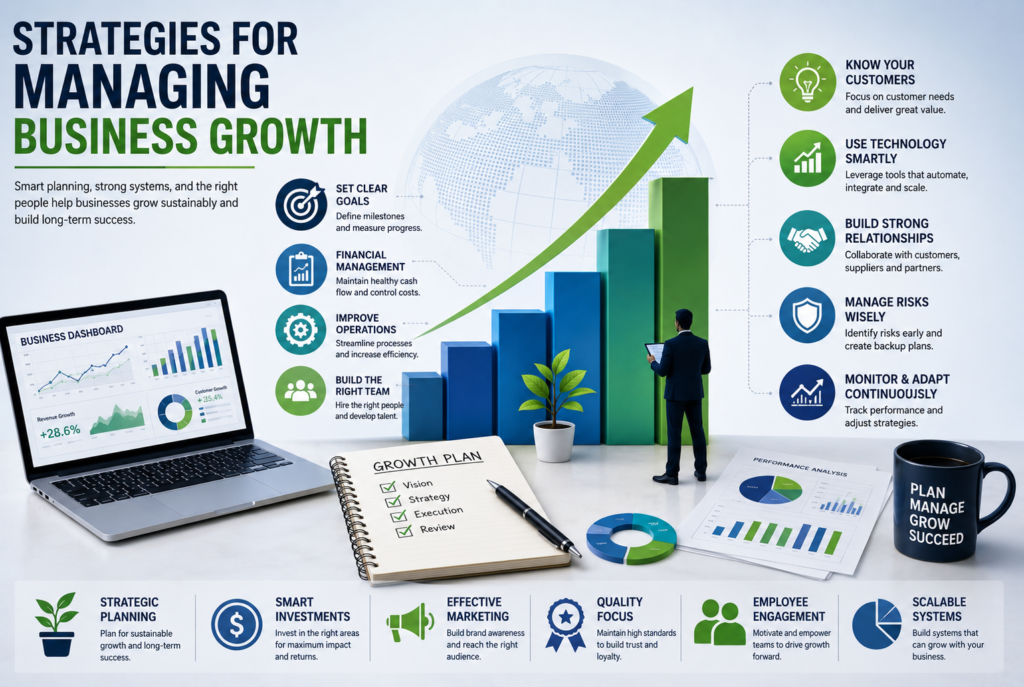
Growth is not only about hiring new employees. Businesses should also invest in the people already working for them.
Employee development can include:
Employees who have opportunities to grow are more likely to remain engaged and contribute to the company’s long-term success.
Business owners often try to manage everything themselves, especially during the early stages. However, this approach can become difficult as the company expands.
Effective delegation allows leaders to:
Delegation works best when responsibilities, expectations, and deadlines are clearly communicated.
One of the biggest risks of rapid growth is declining quality. A business may gain more customers but lose them if products or services no longer meet expectations.
Companies should establish quality standards and regularly monitor:
Growth should strengthen the business without compromising what made customers choose it in the first place.
Customers are essential to sustainable growth. Businesses should continue listening to customers even as their customer base expands.
Companies can improve customer satisfaction by offering:
Satisfied customers are more likely to make repeat purchases and recommend the business to others.
Acquiring new customers can be expensive. Building strong relationships with existing customers can create long-term value.
Businesses can strengthen relationships through:
Customer retention can provide a stable foundation for continued growth.
Entering new markets can create exciting opportunities, but expansion should be based on research rather than assumptions.
Before entering a new market, businesses should study:
Starting with a smaller market test can help businesses evaluate an opportunity before making a large investment.
Businesses can reduce dependence on a single product or revenue source by developing complementary products and services.
For example, a company might introduce:
Diversification can create additional revenue opportunities while serving existing customers more effectively.
Growth can increase demand for materials, products, packaging, and other resources. Businesses need reliable suppliers who can support increasing requirements.
Companies should evaluate suppliers based on:
Strong supplier relationships can reduce disruptions and help businesses respond to increased demand.
A scalable business system can handle increased demand without requiring a proportional increase in costs or effort.
Businesses should ask:
Identifying these limitations early can make future expansion smoother.
Businesses need reliable information to understand whether growth is actually healthy.
Important metrics can include:
Regularly reviewing these indicators helps management identify problems before they become serious.
Growth can expose companies to new risks. These may include financial, operational, technological, legal, and market-related challenges.
Businesses can reduce risk by:
Risk management helps businesses remain stable during unexpected situations.
Rapid growth can change the personality and culture of an organization. As new employees join, businesses need to ensure that their core values remain clear.
Strong company culture can be supported through:
A positive workplace culture can improve employee engagement and help attract talented professionals.
Business growth often requires leaders to move from managing daily tasks to making strategic decisions.
Effective leaders should focus on:
Strong leadership helps ensure that growth remains organized and purposeful.
Growth requires businesses to reach new customers, but marketing spending should be carefully planned.
Companies can use a combination of:
Businesses should measure marketing performance and focus more resources on strategies that generate meaningful results.
Markets can change quickly due to technology, customer preferences, economic conditions, and competition.
Businesses should regularly monitor:
Staying informed allows companies to adapt before major changes negatively affect their growth.
Rapid growth can create problems when a business expands faster than its systems and resources can support.
Signs of unhealthy growth may include:
Sustainable expansion is often better than rapid expansion that creates long-term instability.
Business growth should be treated as an ongoing process. Strategies that work today may need to change as the company develops.
Businesses should regularly review:
Continuous improvement helps businesses remain efficient and competitive.
Sustainable growth means increasing revenue, customers, and market presence while maintaining financial health, product quality, employee well-being, and customer satisfaction.
Instead of focusing only on short-term results, businesses should build systems that can support future expansion.
This approach creates a stronger foundation and reduces the risk of growth becoming difficult to manage.
Managing business growth requires careful planning, strong leadership, financial discipline, efficient operations, and a continued focus on customers. Growth can create exciting opportunities, but businesses need the right systems and people to handle increasing demands.
By setting realistic goals, using technology, developing employees, maintaining quality, monitoring performance, managing risks, and expanding strategically, companies can build a foundation for sustainable success.
Ultimately, successful growth is not simply about becoming larger. It is about creating a stronger, more efficient, and more resilient business that can continue to serve its customers and adapt to future opportunities.